
Holsteins
#28 of 52 Fictions: A Story a Week for 2026

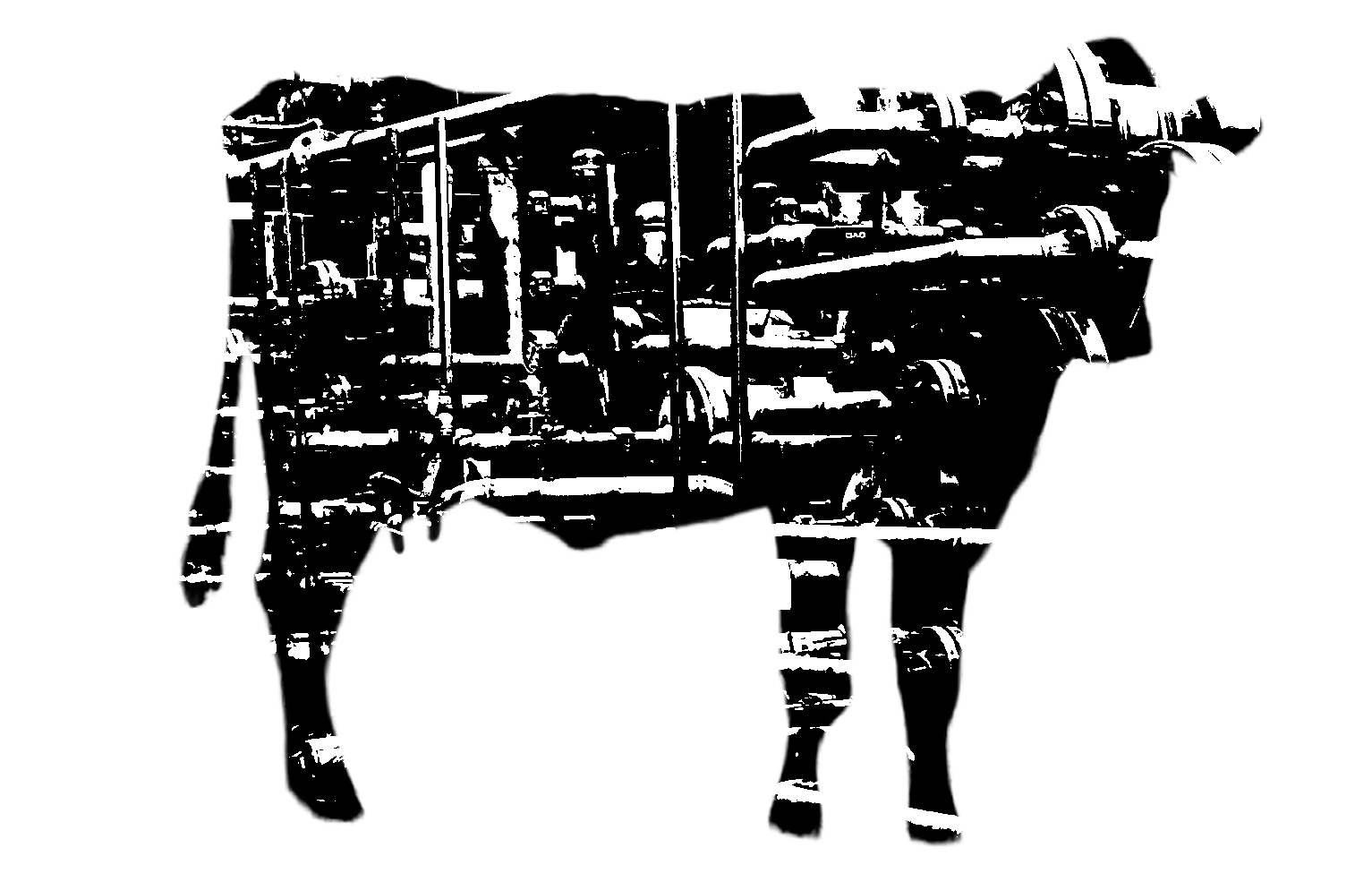
A lot of the big dairies now have facilities that use the cow manure as a feedstock for producing methane, or “biogas.” My work often involves visiting these facilities to look at the machinery and talk with the people running the plant, who are called operators. It’s kind of strange work, I guess, and I’ve learned more than I ever would have expected to learn about cow poop. But it’s funny the things you can get used to, and how a day full of cow poop can become just another day.
This last time, when I pulled into the gravel lot next to the scrubber tanks and got out of my car, a blue jay began began shouting at me. Birds often nest in the nooks and crannies of the equipment. The plant operator was waiting for me in his truck, a gigantic crew cab Ford. Around us the ran the rolling Iowa cornfields, and the midday sun beat through a haze of humidity. I began to sweat more or less immediately. The operator came over, shook my hand, and introduced himself: Del Burton.
Del asked what I wanted to see first, and I said let’s start at the beginning, so he led me to the reception pit, which was an open concrete pit full of fresh cow manure. You have to understand that modern dairies have thousands of cows, and each cow produces many gallons of manure per day. Dairy cow manure is watery stuff, and this big pit held thousands of gallons, with mixers to keep the solids from settling out, so it was churning constantly. It smelled horrible, of course, but when you’ve done this enough, you don’t really notice the smell anymore. At least, it’s that way for me.
From there we walked through the big digester tanks and then the blowers and the compressors and the gas filtration and the containerized gas upgrading equipment. I asked questions, took pictures, and made notes. I had to write a report for a bank. I wore steel-toes, a hardhat, and a high-vis vest, and I carried a four-way gas monitor, per the policies of my employer. Del didn’t have any of that, except for the steel-toes. In my notes I scribbled, “Site safety culture?”
Del had shaggy hair, dirt under the nails, dirty jeans, and skittery blue eyes. I didn’t think a lot about how he looked; in my experience, everyone working on a dairy was likely to be showing stains and grime—including the owners, who are often very wealthy. When Del was thinking about my questions, he would grimace, showing big blocky teeth, and his eyes would squeeze nearly shut, as if to demonstrate how hard he was thinking. I asked about the size of a pump, where a pipe went, how they monitored flow. Del would grimace, then he would declare himself unsure, and then he would speculate. A couple of times, he apologized. He said he had spent fifteen years working the oil fields in Texas, and he had spent the last five years working biogas plants similar to this one, but he had just started this job a week and a half ago. He didn’t know the site very well yet.
We passed beside the barn. In an industrial dairy, the “barn” is an open-sided structure, like a giant warehouse with no walls. Thousands of Holsteins milled around inside. Several of them gazed at us with their big black eyes.
We came to the operator’s control room, a small dingy space, with two screens to monitor the equipment and a single office chair that looked like it had been beaten half to death with a slop bucket. Del went through the controls and data on the screens for me. I tried to be patient, but I was frustrated by how little he knew about the facility. I asked about engineering drawings, and he rummaged in a file cabinet for a while, then came back with a couple of equipment manuals that were useless. I frowned. I asked for the bathroom, which turned out to be a Porta Potty outside the backdoor.
When I came back, Del was in the beaten chair with his head in his hands. He looked up, and he was crying.
Now, the truth is, I was annoyed, and for the first time I began to suspect a something nefarious. If there were things here that someone preferred to obscure from the bank, it would be clever to give me this man who knew nothing, hide the drawings, and put just one chair in the control room. And now, to be rid of me, he was making a show of sobbing.
But he looked at me with dismal, bloodshot eyes, and my suspicions couldn’t bear up. He apologized, and he said what happened was his son died three months ago. Three months ago, he repeated, as if trying to really understand the words. He had thought he was ready to go back to work, he said. He had always worked. Also, he needed the money. My only child, he said. Twenty-one years old. Studying electrical engineering. Took a handful of pills. Never woke up.
I said I was sorry. I looked around awkwardly. Of course there was no place for me to sit. I said I was so, so sorry. I couldn’t imagine. What an awful tragedy, I said. I don’t know what to say, I said.
Del had put his face in his hands again. We were quiet. After a moment I stepped forward to place a hand on his shoulder.
He shook me off. We’re done? he said. He swiveled away, ostensibly to look at the screens.
Sure, I said. Thanks for your time. And I am so sorry for your loss, and—
Then I stood there. And what?
Well, then I left.
I walked beside the long open barn on my way back to the rental car. I thought about men who hold things in until they burst out in some strange place. I had been that man before. I looked at the cows, and the cows looked at me. I felt I had been clumsy and useless to Del, and the cows looked at me without much sympathy.
My own two children were alive and well, so far as I knew.
When I got to the car, I texted both of them that I loved them. Then I started for the airport.
As I drove, I opened the windows to flush the smell of manure from the car. You never know which day will be the one to remind you of the size and terrible delicacy of a life, and you never know what you’ll find yourself thinking at a time like that. Odd things come to mind. They say nothing is black and white, but a Holstein is black and white. That was a thought in my mind, for a moment, while I drove. Then I needed to pull over, so I did, and I sat for a while with the windows open beside a field shining with goldenrod, and I listened to the meadowlarks sing.
An Aside: To be clear, this week’s story is fiction, but the work that the narrator is doing is based on some of the stuff that I do in my engineering job. I have visited many dairy manure-based biogas plants, and I have more or less gotten used to the smell. Most of the places I visit are in remote rural counties of the Midwest, and after I’m done with my work at the dairy, I often go looking for a coffee shop to sit down and scribble a story like this one. I’ve been happily surprised how often you can find very nice coffee shops in the rural Midwest now; that wasn’t the case when I was growing up in Michigan in the 20th century.
Erin works hard here at the 52 Fictions headquarters to craft the perfect illustration for each story. This week’s story posed a puzzle, because in my work I have taken thousands of pictures of pipes, pumps, cow manure, and all the rest of it, and a few of the pictures are even kind of cool, but for the most part I can’t distribute the pictures to public because they are proprietary. In this case we finally settled on distorting a picture of some piping, and Erin melded it, in black in white, with a Holstein. I love it.
Background and implorements: I’m on a mission to write and post a story a week for 2026. Check out this article about the project in Westword!
The stories are free, but here are some other ways you can support the author:
Pass this story forward to a friend.
Post a link on your socials.
Post a review of one of the author’s books.
This story is by Nick Arvin. Check out the previous stories. The fabulous illustrations for these stories are by Erin Schoepke/Lunascape Photograpy. See more of her images here. Follow her on Instagram.
No AI was used in creating this story or the illustration.
Excellent and moving. Sigh.
Another just wonderful, incisive, and brisk short story. You're killing it, Nick. Across genre and tone.