
The Ruined Room
#16 of 52 Fictions: A Story a Week for 2026

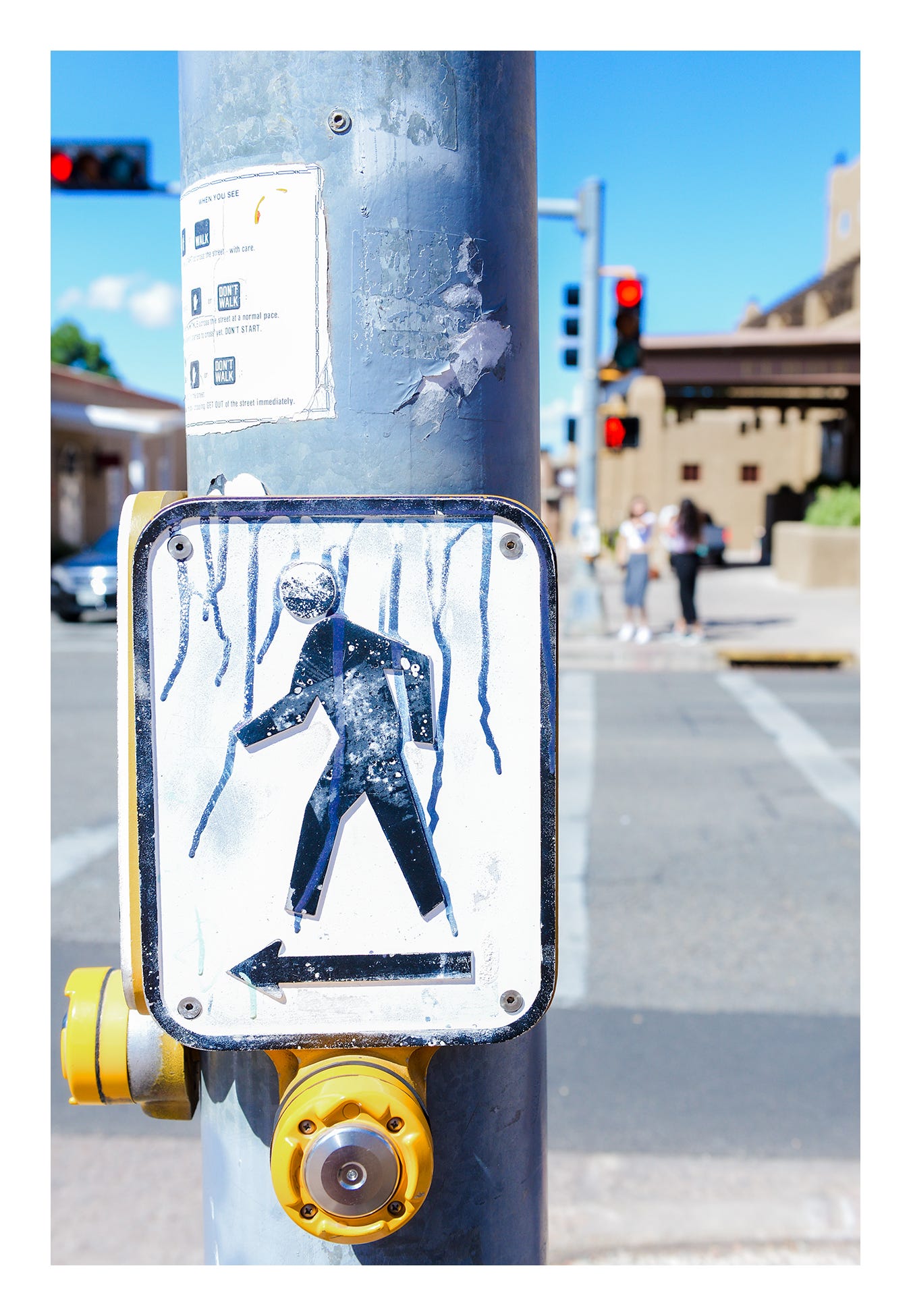
Courtney read in the news about the pedestrian killed in an intersection she crossed nearly every day. Working her first job, at an engineering firm in a building downtown, Courtney liked to walk across the street in the morning for a latte. It had become a ritual, one that felt luxurious and adult. But she had been far away when a pickup ran a red light and hit a pedestrian, throwing her 35 feet. The pedestrian was a young woman, unnamed in the news.
The following morning, when Courtney went down to the street, someone had duct-taped a bundle of lilies and carnations to a light pole. They were already wilting. Otherwise the intersection looked the same as ever. She pushed the button and waited for the signal. There was no traffic, and yet she crossed with heart racing. She had the powerful impression that the pickup truck had just missed her, as if she could feel the wind as it passed by.
It became one of several events that she carried like tiny stones in a secret pocket. Each one seemed to possess a crack so thin it could not be seen, but it could be felt.
Later she married, and they had their two girls, and she quit working for a few years to take care of the girls. It was both wonderful time and a time of private loneliness. They lived in an apartment, too small, with a balcony. It had a steel rail, and when she read of a child near the age of her eldest who pushed on a balcony rail and fell to his death, only a mile away, she went out to look at her own rail, thinking to inspect it. She didn’t know what to look for. She looked at the bolts. She pushed on it. It seemed fine. But she stood gripping it, wondering. It could have been any balcony, any child. She would never have been able to explain it, but she knew that there had been a narrow miss, that the tragedy had befallen someone else by only the slightest of differences. It could have been her own family, and it nearly had been, she felt, and she stood on the balcony, gripping the rail, and weeping.
Certainly it was not something she could ever describe to another engineer. She felt it again that same year when a tornado in Louisiana destroyed a house that looked nearly identical to her parents’ house in Iowa. She felt it few years later, when her husband’s friend and coworker died of esophageal cancer. And she felt it when the family went to the beach during her oldest daughter’s first year of college, and a week later a riptide killed a college-age girl. The death occurred at a beach 50 miles away from where they had been, and there was no rational connection, but she knew happenstance had passed her by, a breath on the back of her neck.
She had returned to her engineering career when her girls were in middle school and had been back at work for a dozen years when she walked into a ruined compressor room in the middle of Wyoming. She felt it immediately, like a spreading fissure in the heart.
A couple of years earlier she had spent a day and a half in this same room, wearing earplugs against the incessant roar of the reciprocating compressors. Now it was silent. An explosion had destroyed everything. No one had been present, and the detonation hadn’t had anything to do with her old project, thank God. A flange on the compressor had cracked.
They wanted to rebuild, so she was here, again. She remembered vividly the way it had been. There had been no existing engineering drawings, so she had had to document every pipe and valve. Now the pipes and valves were blackened, bent, and twisted to all directions. The housings of a pair of pump motors had melted and sagged as if made of wax. Electrical conduits lay in spaghetti piles. A keyboard drooped like a Dali clock. The roof had been blown open by the explosion, and the sunlight poured in, and that was strange, too, because there had been no natural light here. She thought this must be a shadow of the experience of walking into a home that has burned. But she also felt that it was only a passing chance that it hadn’t blown up while she was here. She stood in the middle of the room and look up at the open sky, and all of the possibilities flowed through her in a cold current.
And what then can you do? she wondered. What can you do? You want to make meaning of it. To see a pattern. Why this and not that. You rub the cracks in the stones. You ache at the fissure in the heart. You are not granted the vision of a pattern, and because you are not, you remind yourself: you should be grateful for this moment, and for this moment, and for this. All the true cliches.
But, inevitably, something annoys you, and you forget again while the moments pass on. So, she turned from the sky to do her work.
An aside: “How come you write so many stories about engineers?” I was asked. There are a couple of things about this. One, because I’m an engineer, and I’ve worked with engineers for almost (yikes) 30 years, I feel like I understand intuitively how they think. Especially for this project, where I need to write stories quickly, that’s handy.
For another thing, it allows me to use experiences from my working life in my fiction.
And the last thing, perhaps most important to me, is that engineers are my people, and they are not well represented in fiction. There are lots of novels and stories about doctors, lawyers, writers, politicians, artists, etc., but relatively few about engineers. I like to think I’m granting my trade a small place at the literary table.
If you have a favorite story or novel about an engineer, please drop me a comment or a line. Questions are welcome too!
Background and implorements: I’m publishing a story a week for 2026. Check out this article about the project in Westword!
The stories are free, but there are some other ways you can support the author:
Pass this story forward to a friend.
Post a link on your socials.
Post a review of one of the author’s books.
This story is by Nick Arvin. Check out the previous stories. The fabulous illustrations for these stories are by Erin Schoepke/Lunascape Photograpy. See more of her images here. Follow her on Instagram. No AI is used in creating the story or the illustration.
"A keyboard drooped like a Dali clock." Great image!
Tower of Babylon, Ted Chiang!